
Math grades rise when students stop re-reading and start practising, fix the exact mistakes they keep making, and do it a little every day. That takes a clear routine, worked answers that show each step, and practice that matches the province's curriculum. TM StudyPrep gives Grade 1 to 12 students province-aligned Math lessons, practice exams and step-by-step worked answers in an ad-free space, so the routine below has material to run on.
TL;DR
- Practise problems actively. Reviewing notes alone is the most common reason effort does not become marks.
- Understand why a method works before drilling it, or you risk practising a misconception.
- Keep a list of missed problems, redo it, and use each test result to decide what to study next.
- Ask a teacher a specific question early, not the night before a test.
- Short, regular sessions beat cramming. Parents help most by keeping a steady schedule and a positive attitude.
Table of Contents
- Start by finding where the marks are lost
- Understand the idea, then practise the method
- Practise actively, not passively
- Build a routine that fits real life
- Ask for help early and ask specifically
- What parents can do
- Where TM StudyPrep fits in
- Check that it is working
- FAQ
- Sources
Start by finding where the marks are lost
Before adding study time, find out what is going wrong. Pull out the last two or three tests and sort every lost mark into one of three piles:
- Did not know the concept. The student could not start the problem.
- Knew the idea, slipped on the steps. Sign errors, copying errors, skipped lines.
- Ran out of time or panicked. The work was right but unfinished.
Each pile needs a different fix. Kamloops Polytechnic's math guide tells students to analyze test results to see where more study time is needed. Do that first, and the rest of the plan becomes targeted instead of vague.
Understand the idea, then practise the method
Memorizing a procedure feels productive, but Toronto District School Board's research series says memorizing is not sufficient for understanding. Students are asked to connect steps to the concept behind them, explain their reasoning, and compare correct and incorrect methods.
Ontario's Ministry of Education adds a warning: practice of procedures should come after students have a good understanding of concepts, otherwise they may practise misconceptions. It also says practice works best when it is deliberate and spaced over time, with feedback so students know they are doing it correctly.
In practice:
- After a lesson, ask the student to explain in their own words why each step is done. If they cannot, go back to the concept.
- When they get stuck, compare their attempt with a worked solution line by line and find the first line where the two differ.
- Say it aloud. UBC's math study skills page recommends the Feynman technique, explaining concepts to yourself in plain language.
This is where step-by-step worked answers earn their place. A bare final answer tells a student they are wrong. A full solution shows where. TM StudyPrep pairs its lessons with worked answers for exactly that comparison.
Practise actively, not passively
The University of Manitoba's Academic Learning Centre warns against spending too much time reviewing textbooks and notes without practising problems. It recommends studying soon after class, trying problems before looking at solutions, and keeping a list of problems answered incorrectly so you can redo them.
UBC suggests treating textbook examples as problems: cover the solution, work it on a separate sheet, then check. It also cautions against racing through many problems without pausing. After each one, ask:
- What mistake did I make, and how can I avoid it?
- Which concepts and techniques did I use, and why?
- What advice would I have given myself before starting?
The TDSB research series is a useful caution here too: it cites research finding no significant achievement gain from drill-based homework, and notes that homework helps when it is meaningful and purposeful. Twenty well-chosen problems with reflection beat sixty done on autopilot.
Build a mistake log
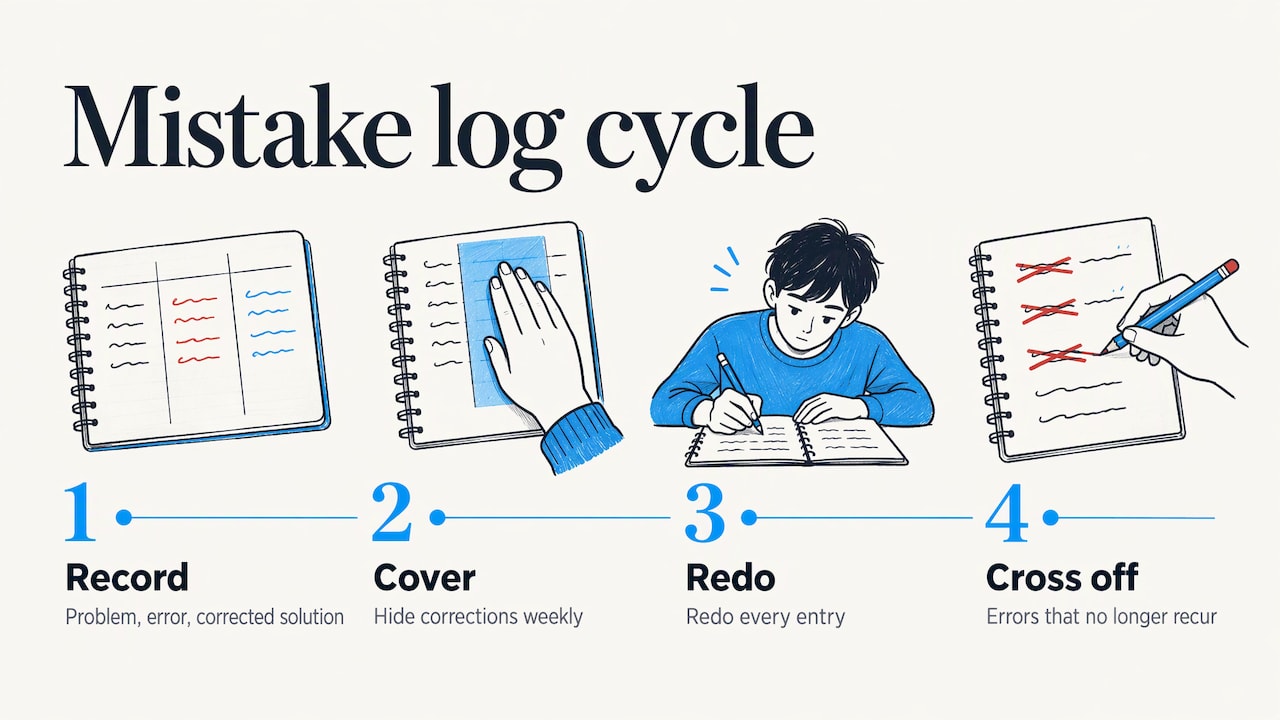
A mistake log is the single cheapest upgrade. Use a notebook with three columns: the problem, what went wrong, and the corrected solution. Once a week, cover the corrections and redo every entry. When a problem stops appearing as an error, cross it off. Before a test, the log is the most personalized study guide the student owns.
Build a routine that fits real life
Kamloops Polytechnic's guide suggests post-secondary students plan at least three hours of outside study per class hour. That is a college figure, and school students need far less. The principle carries over: study a little every day, and review earlier material before starting new material. The same guide recommends keeping a math binder of problems and method notes, and chunking material into short pieces.
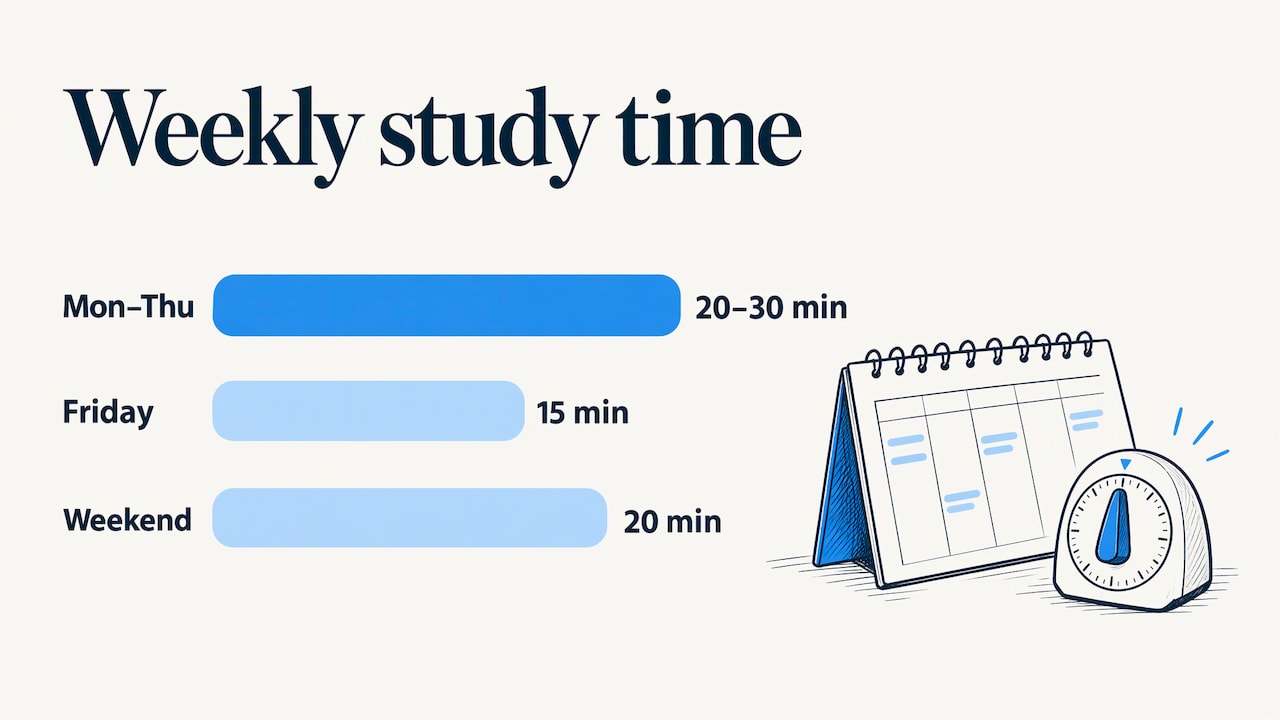
A workable weekly pattern for a school-age student:
| Day | Task | Time |
|---|---|---|
| Mon to Thu | Preview or review the day's lesson, then practise problems | 20 to 30 min |
| Friday | Redo the mistake log | 15 min |
| Weekend | One short mixed set, including older topics | 20 min |
Adjust the minutes to the grade and the child. Shorter and consistent is the goal. Homework policies in Canada also stress balance: one BC school district's guidelines say families should allow time for recreation and family events, so protect downtime.
Keep motivation up
KPU's guide points out that math is like a language with its own symbols, and that not understanding it right away is normal for most learners. Build on small wins: finish a session on a problem the student can solve. For anxious students, a Langley School District guide suggests treating errors as learning opportunities and relying less on timed drills.
Ask for help early and ask specifically
Students often wait until the night before a test. A UBC guide on approaching instructors says to ask early and to bring a specific question rather than saying "I need help", along with class notes and the work in question. Memorial University's Academic Success Centre likewise recommends using office hours and emailing if speaking up in class is uncomfortable, so questions do not pile up.
A good question sounds like this: "On question 4, I got to this line and I am not sure why the exponent changes. Here is what I tried." It lets the teacher see the thinking and fix it quickly.
What parents can do
You do not need to be good at math to help. The BC Ministry of Education's parent guide suggests starting by talking with the child's teacher about what skills the child should have, where the difficulty is, and what can be done at home. It also recommends a quiet study area, a regular schedule and a positive attitude toward math.
Some concrete moves:
- Talk to the teacher early in the term. Education Leadership Ontario's toolkit advises not waiting until the middle of a term.
- Ask your child to teach you. Having them show what they learned exposes gaps fast.
- Use everyday math. Ontario's curriculum context suggests doubling or halving recipes and comparing grocery deals.
- Stay positive. A Langley guide notes that parents are the first influence on a child's feelings about math, and that many learned math differently, so methods may look unfamiliar.
If you suspect the problem is more than a gap in practice, such as a possible learning difficulty, raise it with the teacher, counsellor or school administrator, who can arrange assessment and school supports.
Where TM StudyPrep fits in
The plan above needs three things at home: lessons that match what the class is learning, practice with worked answers, and a way to see whether it is working. TM StudyPrep covers Math, English and Science for Grades 1 to 12 with lessons, study guides, practice exams and step-by-step worked answers that follow each province's curriculum. It is ad-free, students study at their own pace, and parents get weekly progress updates. Each child can have an individual profile, and Grade 12 students can practise for provincial exams.
Plans start with a 7-day free trial. One Subject is $9.99 per month or $79 per year, All Subjects is $14.99 per month or $119 per year, and Family is $24.99 per month or $199 per year. The Grade 12 Exam Pass is a one-off $29. See the plans and start the free trial.

For a student who needs only math, One Subject keeps the routine focused. For a family with several children, or a student who is also behind in English or Science, the other plans cover more.
Check that it is working
Give the plan three to four weeks, then look at evidence rather than feelings:
- Is the mistake log getting shorter, or are new kinds of errors appearing?
- On the next quiz, are the lost marks in the same pile as before?
- Can the student explain a solved problem without looking at it?
- Is the student starting homework without being asked?
Use each quiz or test the way KPU suggests, as information about where to spend the next week of study. If the marks lost have moved from concept gaps to slips, the plan is working, and the next step is checking work and managing time.
FAQ
How can I get better grades in math quickly?
There is no shortcut, but the fastest gains come from fixing repeated mistakes. Sort lost marks from recent tests, redo those problems without looking at the solutions, and study a little every day. Reading over notes alone gives much less.
How many hours a week should a student study math?
It depends on grade and need. A college guide from Kamloops Polytechnic suggests three hours outside class per class hour, but school students need much less. Short daily sessions of 20 to 30 minutes plus a weekly review are a sensible start, adjusted to your child's age and schedule.
Should my child memorize formulas?
Memorizing helps only when the student also knows why the formula works. Research summarized by the TDSB says memorizing alone is not enough for understanding. Have your child explain each step in their own words and compare it with a worked solution.
When should we ask the teacher for help?
As soon as a topic stops making sense, and not the night before a test. Bring a specific question and the work you have tried, so the teacher can see exactly where the thinking went off track.
Sources
- Math Success, Kamloops Polytechnic (study guide)
- Succeeding with Math, Kamloops Polytechnic
- Effective Instructional Strategies, TDSB Teaching and Learning Math series
- High-Impact Instructional Practices in Mathematics, Ontario Ministry of Education
- Efficient studying, UBC 1st Year Math Study Skills
- How to Study for Math and Science Courses, University of Manitoba
- Homework guidelines, SD 38
- Balanced Numeracy, SD 35
- How to Approach Instructors, UBC wiki
- Communicating with Instructors, Memorial University
- Parent Numeracy, BC Ministry of Education
- Parent Tool Kit, Education Leadership Ontario
- Mathematics Curriculum Context, Ontario Ministry of Education